top of page


NEWS
Search


(New Publication) Disturbance shifts belowground plant nutrient acquisition strategies in a tropical peat swamp forest
Tropical peatlands are critical carbon sinks that store up to 25% of the tropical terrestrial carbon pool. In Southeast Asia, these ecosystems are threatened by land use change, which accelerates peat decomposition and releases stored carbon into the atmosphere. Despite their importance, our understanding of the belowground carbon mechanisms that regulate carbon storage in tropical peat swamp forests remains limited. Badas peat dome. Photo 2024 Sean Yap. In this study publish

Xin Rui Ong
Nov 172 min read


Tropical Ecology & Entomology (TEE) Lab Wins 2026 Singapore Open Research Award
(From left to right) Marx Yim, Associate Professor Eleanor Slade, Dr Ong Xin Rui, Dr Chiew Li Yuen The Tropical Ecology & Entomology (TEE) Lab from the Asian School of the Environment (ASE) of NTU was named a winner at the 2026 Singapore Open Research Awards for our Global Biodiversity Information Facility (GBIF) project, "Mobilising Data on Ecologically Important Insects in Malaysia and Singapore" [Link]. Led by Associate Professor Eleanor Slade, the project was carried out

Marx Yim
Nov 102 min read


(NEW Publication) Dung beetle declines merit global attention
Insect populations are declining worldwide, raising concerns about the loss of biodiversity and essential ecosystem services that insects provide. Yet, despite their ecological importance, some insect groups remain overlooked. Among them are dung beetles, a critically important insect group that provides several important services such as nutrient cycling , soil aeration and seed dispersal. Graphical abstract. Source: Cavallaro et al. (2026) In this Forum article published in
Xin Rui Ong
Oct 191 min read
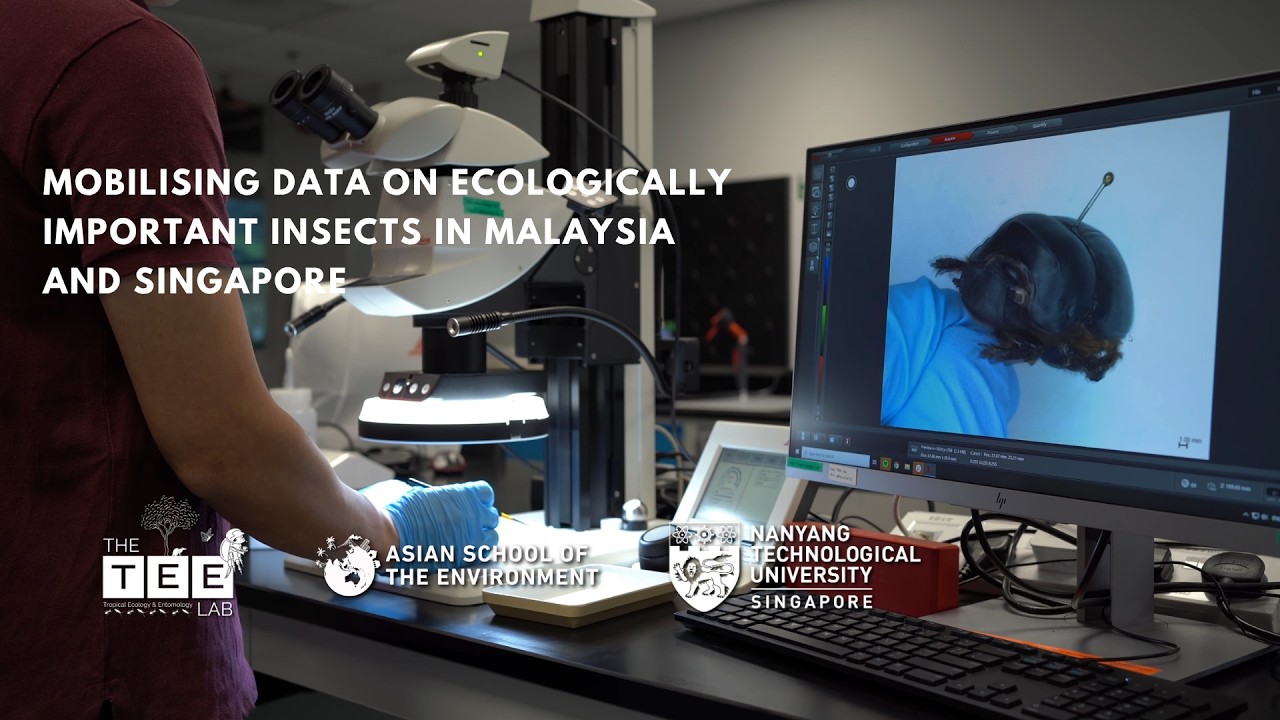
Mobilising Biodiversity Data on Sabah’s Dung Beetles
Through our Global Biodiversity Information Facility (GBIF) project, Mobilising Data on Ecologically Important Insects in Malaysia and Singapore, we brought together information on dung beetles (Scarabaeinae) from scientific literature, museum collections and data collected from the field. Focusing on dung beetles in Sabah, Malaysian Borneo, our work has resulted in an open-access sampling event and occurrence dataset containing more than 27,000 records, alongside a taxonomic
Marx Yim
Oct 91 min read


New Publication: From Singapore's Forests to Parks- Impacts of Urbanization on Dung Beetle Communities in a Tropical Island City
Southeast Asia is a hyper-diverse and rapidly urbanizing region. However, the impacts of urbanization on the region's insect communities are still greatly understudied. In our recent publication in Biotropica's Special Issue: Urban Ecosystems, Ecology, and Evolution in the Tropics 2026, we investigated the impacts of urbanization on Singapore's dung beetle communities - an ecologically important and ideal bioindicator group. Deployed flight-interception trap and baited pitfal
Xin Rui Ong
Sep 112 min read


NEW PUBLICATION: Systematic & exhaustive wood dissection: a standardized method for studying saproxylic insect communities in tropical rainforests
Saproxylic insects, insects dependent on dying or dead wood for survival, are very important in performing various ecosystem functions and services. Saproxylic insects range from Stag Beetle larvae that feed on decaying deadwood, to social parasites that live with ants nesting in deadwood. Other than carrying out nutrient cycling as they decompose deadwood, some saproxylic insects are pollinators (e.g. flower chafers and some longhorn beetles), and some are important food sou
Calvin Leung
Aug 43 min read


New Publication: Using Metabarcoding Techniques to Map Multiple Dung Beetle-Vertebrate iDNA Networks in a Southeast Asian ForesT
Species interact with each other through complex ecological networks. The structure of these networks can be altered by anthropogenic drivers, such as agricultural expansion and climate change, which may impact ecosystem functioning. Increasingly, molecular techniques are being used to monitor biodiversity and construct ecological networks, circumventing the constraints associated with using conventional means to document species interactions over time and space. Field survey
Xin Rui Ong
Jun 262 min read


(NEW Publication) The hidden consequences of elephant extinction
Large mammalian herbivores are important keystone species that are increasingly threatened by hunting and global environmental change. Their loss can trigger cascading impacts on other organisms that rely on them, including dung beetles—ecologically important insects rely on the feces of larger animals for feeding and nesting. By processing and burying dung, dung beetles also contribute towards multiple ecosystem services, including nutrient recycling and seed dispersal. Scie
Xin Rui Ong
May 291 min read


Predictive entomology: Understanding and forecasting insect population change
Insects are responding rapidly to global environmental change, yet understanding why insect populations change remains one of the greatest challenges in ecology and conservation. While monitoring efforts increasingly reveal shifts in insect abundance, diversity, biomass, and distributions, observed patterns are often shaped by multiple interacting drivers, biological mechanisms, and even the way insects are detected and measured. In our new paper, Predictive entomology: A c
Tharaka
May 252 min read


(Media Feature) The Borneo Post: Study puts Sabah’s dung beetles on the global conservation map
Our recent study, Towards red listing understudied tropical insects: A case study of the dung beetles of Sabah, Malaysian Borneo , has been featured in East Malaysia's daily newspaper, The Borneo Post ! We thank Dr Arthur Chung and Datuk Frederick Kugan for the opportunity to contribute this article in collaboration with the Sabah Forestry Department. Check out the article and our publication in these links: Study puts Sabah’s dung beetles on the global conservation map To
Xin Rui Ong
Feb 201 min read


(New Publication) Towards red listing understudied tropical insects: A case study of the dung beetles of Sabah, Malaysian Borneo
The IUCN Red List is the most authoritative source of the extinction risk of species and is widely used to inform conservation actions. However, tropical insects are very much under-represented in the Red List due to multiple reasons: limited data on species distributions and trends, difficulties in applying the Red List Criteria, lack of coordination between tropical entomologists and the IUCN structures responsible for publishing official assessments. In our latest publica
Xin Rui Ong
Feb 32 min read


(New Publication) Narrow thresholds of canopy disturbance determine the microclimate buffering potential of tropical forests
Tropical forests are highly diverse and are of significant conservation value. Yet, the continuing disturbance of these habitats, coupled with the effects of climate change, has profound impacts on microclimates and tropical forest organisms. In this study published in iScience , the authors investigated the microclimatic buffering capacity at the scale of functionally important invertebrates along a gradient of forest disturbance (quantified by canopy cover) in the Stability
Xin Rui Ong
Nov 5, 20251 min read


Biodiversity in the city: TEE Lab research featured in The Straits Times
We are proud to share that recent research from the Tropical Ecology and Entomology Lab (TEE Lab) at the Asian School of the Environment...
Li Yuen
Aug 8, 20251 min read


OUR URBAN BUTTERFLY STUDY FEATURED IN THE MEDIA!
We are delighted to share that our recent study on butterfly biodiversity in Singapore’s urban environment has been featured by NTU...
Tharaka
Apr 23, 20251 min read


Flower-rich, less-cut road verges support butterflies in urban environments
Urban road verges, often overlooked as simple roadside greenery, can serve as valuable habitats for butterflies and other insect...
Tharaka
Mar 4, 20252 min read


(New publication) Tropical forest clearance impacts biodiversity and function, whereas logging changes structure
Tropical forests are vital for supporting biodiversity and providing essential ecosystem services, but they are highly vulnerable to...
Ng Wan Lin
Jan 21, 20251 min read


NEW PUBLICATION: Identifying Knowledge & Capacity Gaps in Southeast Asian insect conservation
The hyper-diverse tropical region of Southeast Asia is experiencing high levels of anthropogenic impacts, such as deforestation and...
Xin Rui Ong
Jan 8, 20252 min read


New Publication: A Comprehensive Synthesis of Dung Beetle Records (Coleoptera: Scarabaeidae: Scarabaeinae) from Sabah, Malaysia
With the aim of enhancing the understanding of dung beetle taxonomy and their distributions in Southeast Asia, we are excited to announce...
Marx Yim
Oct 8, 20242 min read


(New Publication) Thresholds for adding degraded tropical forest to the conservation estate
A new study published in Nature reveals the significant conservation value of degraded tropical forests. The study analysed the impact...
Ng Wan Lin
Sep 10, 20241 min read


(NEW PUBLICATION) Invertebrate-Mediated Ecosystem Processes are Resilient to Disturbance Across a Land-Use Gradient in Borneo
Ecosystem functions are important processes that regulate energy fluxes, nutrients, or organic matter within the ecosystem. Many of these...
eleanorslade
Jun 18, 20241 min read
bottom of page