


Predictive entomology: Understanding and forecasting insect population change
Insects are responding rapidly to global environmental change, yet understanding why insect populations change remains one of the greatest challenges in ecology and conservation. While monitoring efforts increasingly reveal shifts in insect abundance, diversity, biomass, and distributions, observed patterns are often shaped by multiple interacting drivers, biological mechanisms, and even the way insects are detected and measured.
In our new paper, Predictive entomology: A causal framework for detecting and attributing insect population change, we propose an integrative framework that links environmental drivers, mechanistic pathways, detection processes, causal inference, and ecological forecasting within a single conceptual structure (see Figure 1).
Environmental pressures such as climate change, habitat modification, pollution, pesticides, and urbanisation influence insect populations through interacting physiological, behavioural, ecological, trait-mediated, and evolutionary processes. However, the signals we observe are also filtered through detection, because monitoring methods capture activity-dependent and context-dependent observations rather than direct measures of true population change. As a result, apparent increases, declines, or stability in insect populations may partly reflect variation in detectability, sampling design, or environmental conditions rather than underlying ecological responses alone.
Predictive entomology therefore emphasises explicit causal inference to separate true driver effects from confounding processes and detection artefacts, allowing more robust attribution and forecasting under future environmental change.
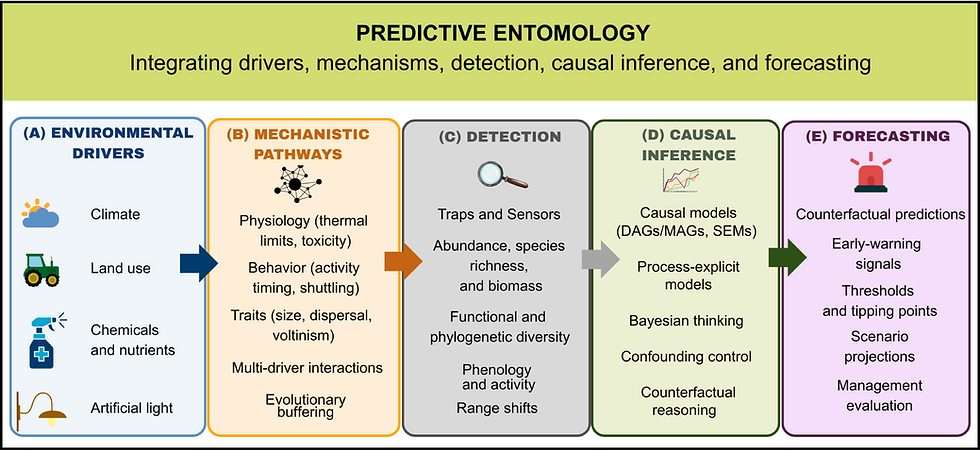
Realising predictive entomology will require coordinated advances in long-term monitoring, mechanistic and experimental research, causal inference, and process-explicit forecasting models. Together, these advances can help move insect ecology toward a more predictive science capable of identifying emerging risks, improving biodiversity forecasting, and guiding proactive conservation under rapid global environmental change.
For more details, check out our paper published in Current Opinion in Insect Science, at https://doi.org/10.1016/j.cois.2026.101538
Please cite our article as: Priyadarshana, T. S. & Slade, E. M. (2026). Predictive entomology: A causal framework for detecting and attributing insect population change, Current Opinion in Insect Science. https://doi.org/10.1016/j.cois.2026.101538


Comments