top of page


NEWS
Search


Chasing Dung Beetles across Sri Lanka
Hello everyone! I am Nethmi, a PhD student at the Tropical Ecology and Entomology (TEE) Lab, Asian School of the Environment, Nanyang Technological University (NTU), Singapore. My research focuses on understanding the diversity, distribution, and ecology of dung beetles in Sri Lanka, particularly how their communities respond to differences in climate and habitat conditions. From July to mid-September 2026, I embarked on my first field season, exploring dung beetle communitie
Li Yuen
21 hours ago3 min read


TEE Lab at the SCIENCE+ Meeting on Safeguarding Anthropocene Tropical Forests
How do we know whether a tropical forest is truly functioning? Is monitoring biodiversity and forest cover enough, or should we also be measuring the ecological processes that keep forests alive? These were among the important questions explored at the SCIENCE+ Meeting, “Safeguarding Anthropocene Tropical Forests,” held on 5–6 October 2026 at the Royal Society, London, UK. Our lab member, Dr Li Yuen, had the opportunity to present her research and contribute to discussions al
Li Yuen
3 days ago2 min read
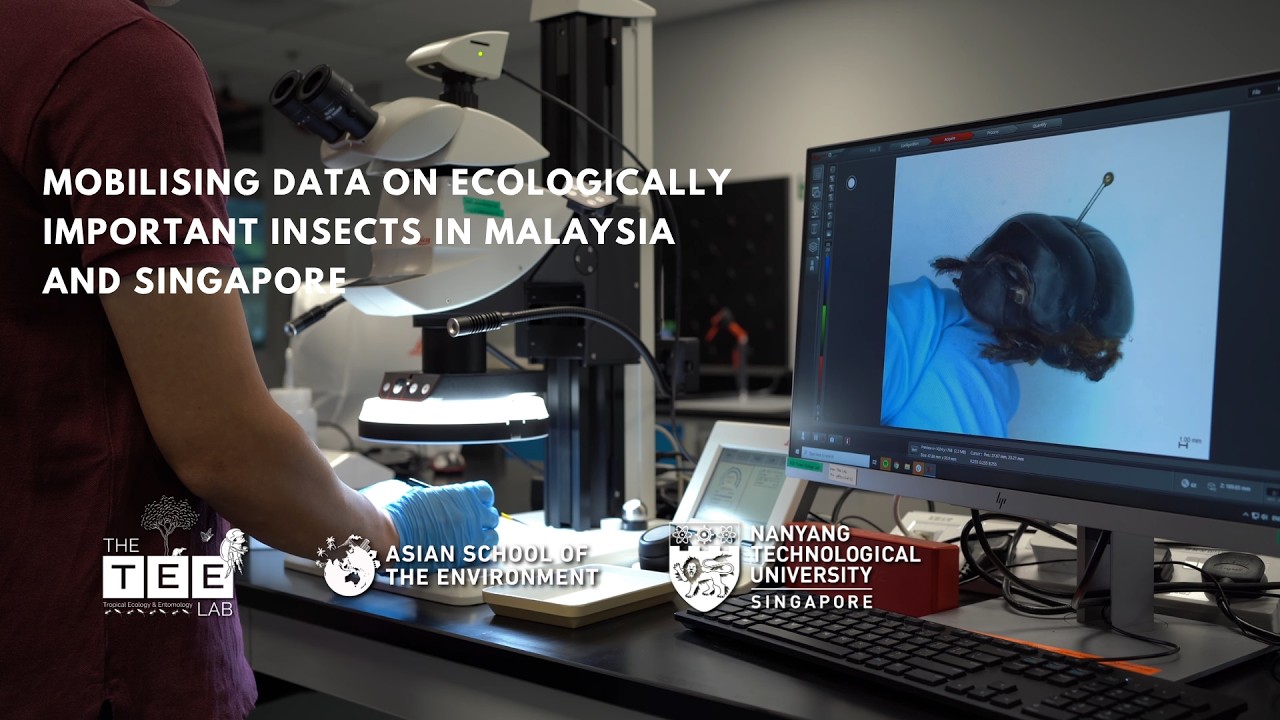
Mobilising Biodiversity Data on Sabah’s Dung Beetles
Through our Global Biodiversity Information Facility (GBIF) project, Mobilising Data on Ecologically Important Insects in Malaysia and Singapore, we brought together information on dung beetles (Scarabaeinae) from scientific literature, museum collections and data collected from the field. Focusing on dung beetles in Sabah, Malaysian Borneo, our work has resulted in an open-access sampling event and occurrence dataset containing more than 27,000 records, alongside a taxonomic

Marx Yim
6 days ago1 min read


JSPS Meeting with DR Ochi & DR Kon
On 1 and 3 October 2026, TEE Lab's Associate Professor Eleanor Slade and Dr Ong Xin Rui visited renowned Southeast Asian taxonomists Dr Teruo Ochi and Dr Masahiro Kon in Osaka, Japan. We had productive discussions in Dr Ochi's home and were fascinated by his extensive and incredible private collection of dung beetles and other insect groups. Group photo with Dr Ochi and Dr Kon, with Eleanor holding a putative new species to science! Photo 2026 Xin Rui. Dr Ochi showing us his

Xin Rui Ong
Oct 61 min read


China-ASEAN Young Scientists Dialogue on Artificial Intelligence and Biodiversity
Between 18 and 21 September 2026, TEE Lab Project Officers Ng Wan Lin and Marx Yim were invited to Nanning, China, to attend the 2026 China-ASEAN Young Scientists Dialogue on Artificial Intelligence (AI) and Biodiversity. Photo credit: World Association for Young Scientists (WAYS) Hosted by the World Association of Young Scientists (WAYS), the Guangxi Association for Science and Technology, and the Guangxi Academy of Sciences, the dialogue brought together young scientists an
Marx Yim
Sep 244 min read
bottom of page