


Gardens by the Bay Sharing Session
The Tropical Ecology and Entomology Lab (TEE Lab) got acquainted with the team from Gardens by the Bay Sustainability Office when we got invited to their BioBlitz in 2025. Following that, we moved onto partnering with them to monitor nocturnal insects within the Gardens under AMBER Project.
Two systems, Automated Monitoring of Insects (AMI) and LepiSense, were deployed in the Gardens late 2025. The data collection was recently concluded and we were invited to share the preliminary findings at the Gardens on the 29th June 2026. This sharing session is part of their capacity building within the Gardens teams for their staff and volunteer guides.
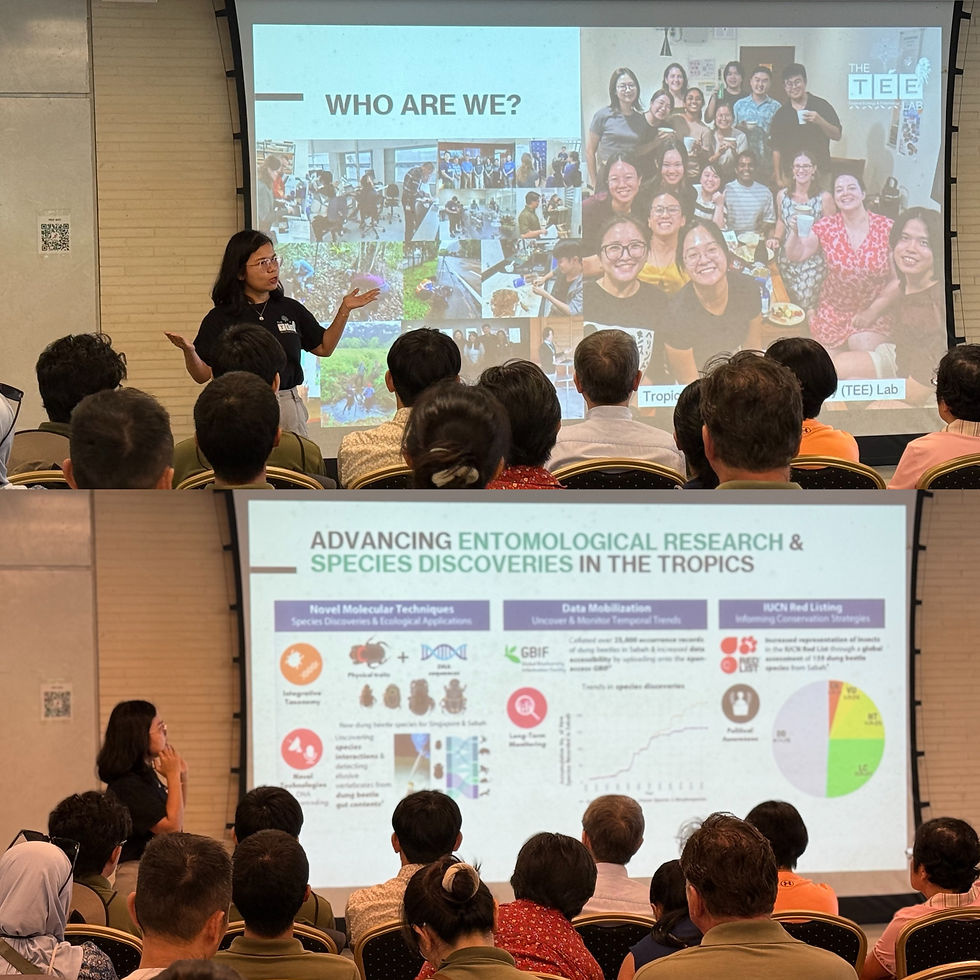
Dr Chiew Li Yuen opened the sharing session by introducing our lab and projects. She shared on our research topics covering tropical urban landscapes, land-use impacts assessments and advancing entomological research, as well as species discoveries in the tropics. Aside from research, she also highlighted our work on the side doing cross-boundary collaborations and public engagement.
Our MSc student, Aorui, joined us in this event to share about his pollinator rooftop project, as Gardens is also part of his data point. Urbanisation reduces and fragments pollinators' habitats. His project looks at rooftops as an ecologically functional pollinator habitat and their feeding interactions.

Finally, Project Officer Wan Lin and PhD student Travis introduced the AMBER Project to the audience. Travis covered how the bioacoustic data was collected and the process that he ran for his analysis of the Songmeter data for birds identification.
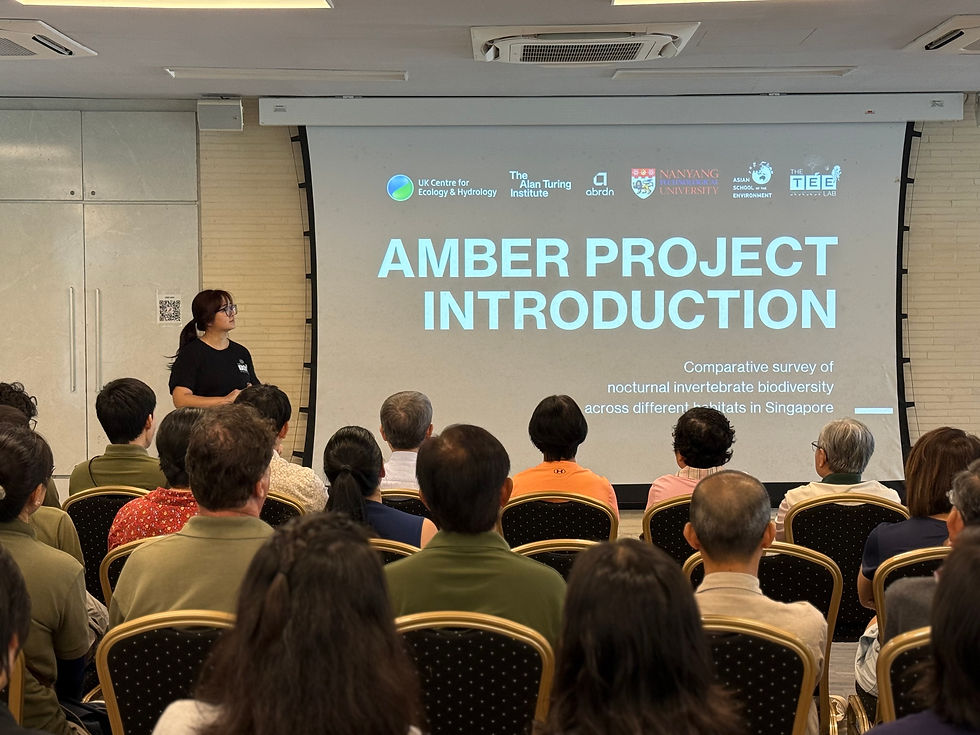


Wan Lin shared how the image data set was processed by our UKCEH partners through an analysis pipeline. Preliminary results of the moth and orders identication were shared with the audience. As the AMBER Project leverages on Machine Learning (ML) algorithms to identify moths and other invertebrates from the image data set, the preliminary results proved that a lot more work is needed to build the data bank to train these algorithms on tropical insects identification, especially moths. These models are primarily trained on data sets of temperate species of moth and orders. Tropical species are severely understudied and documented, hence there is this large knowledge gap that exists in studying tropical invertebrates/insects, especially nocturnal ones.
The misconception is that these technologies are able to provide immediate improvement in operations upon immediate deployment and usage. AI/ML models need access to complete, consistent, relevant data to formulate patterns for accurate predictions. They are only as reliable as the data that are fed to them.
Moving forward, moth (and other taxa in the future) experts/taxonomists have to be engaged to validate these data sets through ID-ing and labelling. Compared to those curated open source pictures of insects (taken from the dorsal view, often with good camera/lens), the systems capture the insects at varying angles and sometimes may not even be in good lighting. That is where the experts' help come in: to identify the insects in such images so that once the data sets are being labelled and verified, they can be used to train the models, increasing the confidence levels of the insect recognition for future data sets. Large amount of validated data on tropical species is required to improve the robustness and accuracy of the order and species algorithms.
The sharing session ended off with an on-site show-and-tell of the LepiSense system at the rooftop garden where it was deployed for data collection.

We would like to express our heartfelt appreciation to the Gardens by the Bay Sustainability Office team for inviting us to this sharing session and for the continued support for the AMBER Project.
A big thank you as well to all Garden Ops staff for their help and support during the study period.
To learn more about the AMBER Project, check out our CNA feature at Gardens by the Bay here:

Comments