


🔬 Strengthening Taxonomic Capacity in Southeast Asia: TEE Lab at the JSPS Meeting in Hiroshima

The Tropical Ecology & Entomology Lab (TEE Lab) recently participated in a fruitful series of meetings and hands-on training sessions in Osaka and Hiroshima, Japan, as part of our collaboration under the Japan Society for the Promotion of Science (JSPS) grant titled: "Building capacity for biodiversity identification and monitoring of ecologically important insect taxa in Southeast Asian ecosystems."
TEE Lab members met with Southeast Asia dung beetle experts, Dr. Teruo Ochi and Dr. Masahiro Kon at the Osaka Museum of Natural History. Drs. Ochi and Kon are the world's experts on SE Asian dung beetles, and have described many of the dung beetle species from Sabah and Singapore. We worked closely with them to examine our pinned specimens and were able to compare them with their reference collections. We will work with them to describe new species and to provide essential baseline data for long-term biodiversity monitoring and conservation planning in the region.

One of the highlights of the trip was a hands-on workshop led by Dr. Ochi, where he trained our team on dissecting the internal part of aedeagus (internal genitalia) of dung beetles – a key structure used in accurate species identification. Additionally, we also learnt to dissect and examine the mouthparts, which are an additional morphological trait essential for taxonomy.

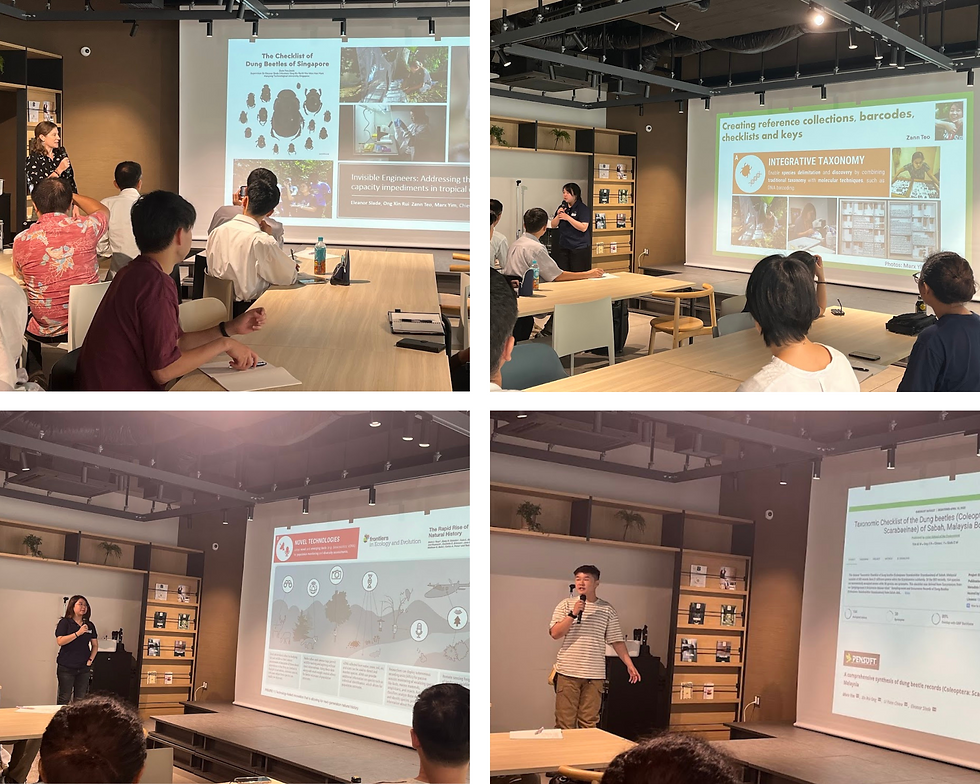
The TEE Lab was also invited to share a series of short presentations on our ongoing projects at Hiroshima University. Prof. Eleanor Slade presented on Addressing taxonomic and capacity impediments in tropical entomology, highlighting the urgent need to strengthen regional expertise for insect biodiversity research. One of our PhD students, Zann Teo showcased her work on developing reference collections, DNA barcodes, checklists, and identification keys for Singapore's dung beetles. Dr. Ong Xin Rui also shared her research on adapting novel and emerging tools, such as eDNA for monitoring populations and assessing insect diversity in tropical ecosystems. Our project officer, Marx Yim presented on data digitization and integration with GBIF, emphasizing the role of open-access data in supporting long-term biodiversity monitoring.
We are excited about this opportunity to collaborate closely with experts who share a passion to discover the rich but often overlooked insect diversity of Southeast Asia. Stay tuned as we continue to work on our new species discoveries!


Comments