


Studying Dung Beetles Across the Causeway: A Visit to Malaysia’s UM & FRIM

From 8 to 18 December 2025, TEE Lab’s PhD student Zann Teo Jiexin and Project Officer Marx Yim made a visit to Kuala Lumpur, Malaysia to study and image dung beetles of Peninsular Malaysia to provide additional insight into Zann's PhD topic on Singapore dung beetles. During this visit, we were privileged to have visited two collections – the Museum of Zoology of Universiti Malaysia (UM) and Forest Research Institute Malaysia (FRIM) – with the company of Malaysian dung beetle researcher Dr Thary Gazi Goh.
In our study of Singapore dung beetles, it is important to also understand the diversity of dung beetles of nearby regions, especially of those in the Malay Peninsula. Comparisons between individual specimens and overall species composition give us insight into both the taxonomy and ecology of these species, allowing us to better answer questions such as how widespread a species may be, or the range of morphological variation that may be found in a single species.

For the first week of our visit, we visited the collections of Dr Thary Gazi Goh, deposited at Universiti Malaya. Marx and I were both astounded by some of the species found in Peninsular Malaysia, such as species of Parascatonomus (Peculiaricerus). This subgenus Peculiaricerus features such unique antennae, and we have no similar species to it in Singapore. Of course, we were also amazed by the size of Heliocopris tyrannus, an elephant dung specialist species that was once recorded in Singapore, and is still extant in Peninsular Malaysia today.


In the second week, we visited the Entomological Reference Collections of the Forest Research Institute of Malaysia. Here, we saw a different series of collections – primarily specimens collected in the 1900s! In addition, many of these specimens have also been identified before by taxonomists, which give us additional certainty on species identity. Having the opportunity to visit both collections in this trip was beneficial, as the memory of discussions at UM were still fresh, and we could make more comparisons between what we saw at UM and what was deposited at FRIM. FRIM also had several species that were not available at UM, making the visit extra worthwhile!
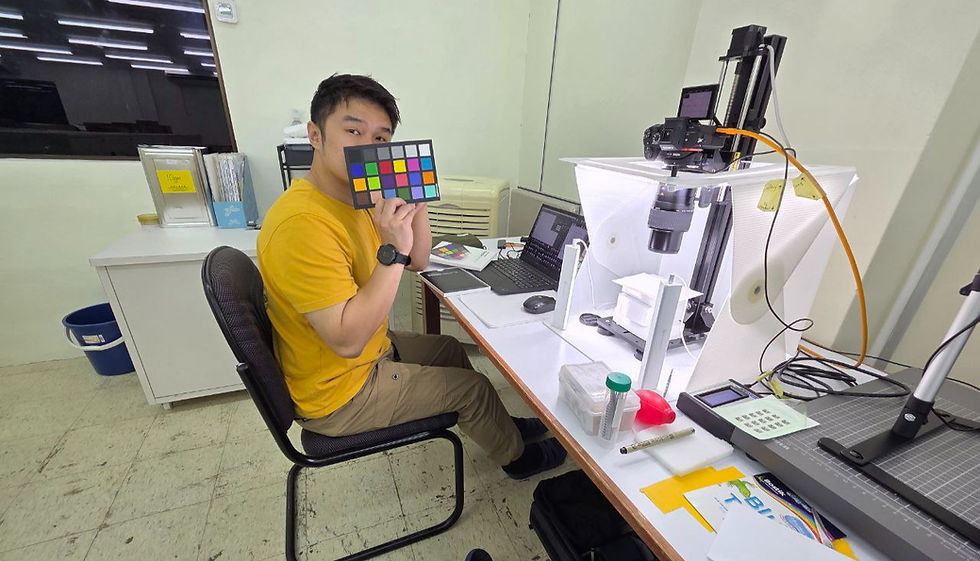

This visit was also especially fruitful due to the generous sharing of knowledge from Dr Thary, which gave us further insight into the natural history of our shared species.
We are grateful to Dr Thary, Universiti Malaya and the Forest Research Institute Malaysia for hosting us over this 10-day visit. We look forward to future opportunities to connect and foster these cross-border collaborations. Terima kasih!


Comments